
Guide · Inspection
Hidden roof damage: when an Indiana roof needs an inspection
The most expensive roof damage in Central Indiana is usually the kind nobody can see from the driveway. Hail bruises that take a season to show, shingles a windstorm unsealed without moving, water that has been in the deck for a year before a stain appears. This guide covers what hides, what it does to a house while it hides, and when a roof genuinely needs someone on it.
A roof that has failed is easy to recognize. Shingles in the yard, a stain on the ceiling, a bucket in the hallway. Those are not the roofs that cost people the most money. The expensive ones are the roofs that look fine: from the street, from the car, from the second-floor window. Damaged in a way that does not show, and quietly getting worse.
That gap between what is visible and what is true is the whole reason roof inspections exist. It is not a sales construct. It is a consequence of how roofs fail, where people stand when they look at them, and what Indiana weather does to them between looks.
This guide is about that gap. It is written to be useful whether or not you ever call us: the triggers and the checklist apply to any competent inspector in any market.
Why the view from the ground is not an inspection
Stand in a driveway and look up at a roof. You are seeing one or two slopes, at a grazing angle, from thirty or forty feet away, usually with the sun somewhere inconvenient. Granules are about the size of coarse sand. A hail bruise is a soft spot under them. A shingle whose seal strip let go in the last windstorm is lying perfectly flat until the next one. None of that is visible from where you are standing, and very little of it is visible from a ladder at the eave either.
Figure 1 · What the driveway can and cannot see
The table below is the same idea, sorted by where you have to be standing. The right-hand column is why the industry has a job called inspector.
| From the ground | Only on the roof | Only in the attic |
|---|---|---|
| Missing or flapping shingles, sagging lines, heavy moss, dented gutters and vents, debris | Hail bruises, unsealed shingles, cracked boots, lifted flashing, exposed nails, soft decking underfoot, granule loss by slope | Daylight at penetrations, stained or dark sheathing, wet insulation, frost or condensation, mold, bypasses that feed ice dams |
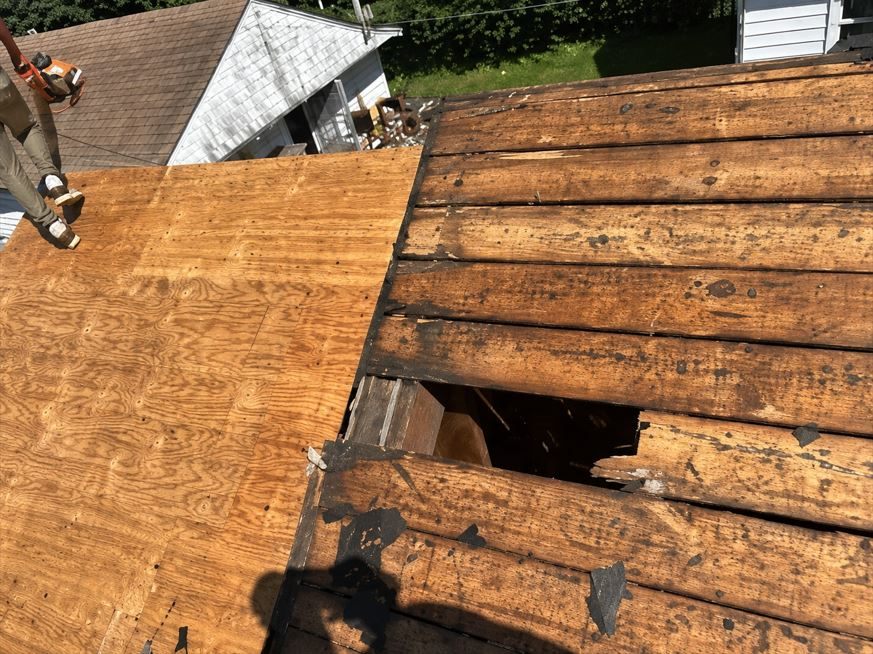
Photo 1 · The same roof, from where an inspection starts
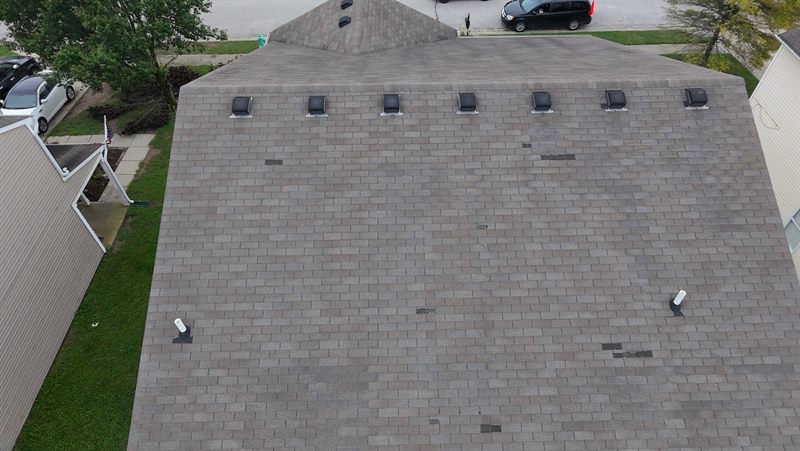
What Indiana weather does to a roof, by season
Central Indiana is not the most violent roofing climate in the country, and it is worth saying so plainly. A multi-year Midwest climatology puts the Indianapolis region at roughly 13 severe-weather days a year, fewer than much of the region to its west. What makes Indiana hard on roofs is not a single brutal season. It is that every season brings a different stress, and a roof here never gets a year off.
The spring and early summer storm season brings the hail and wind: across the Midwest, hail and damaging-wind days both peak in June, and May is typically Indiana’s most active month. Summer brings the ultraviolet and attic heat that age asphalt and cook sealant. Fall drops leaves into valleys and gutters. Winter brings the freeze-thaw cycles that work at every fastener and, with enough snow and a leaky attic, the ice dams covered in our guide to why roofs leak.
And the hail trend is not imaginary. In State Farm’s reporting on its 2025 hail losses, which exceeded $5.6 billion nationally, Indiana was among the states that entered the insurer’s top ten for hail claims that year after not appearing in 2024.
Figure 2 · Roof stress calendar, Central Indiana
- Hail and damaging wind (peak May to June)APR–JUL
- Ultraviolet and attic heat aging shingles, boots and sealantJUN–SEP
- Leaf debris loading valleys and guttersOCT–NOV
- Freeze-thaw cycling and ice dammingDEC–MAR
The practical consequence is that a Central Indiana roof accumulates small, invisible damage on a yearly rhythm, and the damage from one season sets up the next. Shingles a June storm unsealed are the shingles a November wind removes. Granules hail knocked loose in May are the bare asphalt August bakes. An attic that leaks heat all winter grows the ice dam that pushes water under the eave in February.
Five kinds of damage that hide
These are the conditions inspectors find on roofs whose owners were confident nothing was wrong. Each one is invisible from the ground for a different reason.

1 · Hail bruising
A hailstone that does not break the surface still crushes the granule bond and can fracture the fiberglass mat beneath. The spot is soft to a thumb and invisible to an eye. Over the following months the loosened granules wash off, the exposed asphalt takes ultraviolet it was never meant to take, and the roof ages years ahead of its neighbors. Hidden because the damage is under the surface, and because it develops on a delay.
2 · Unsealed and creased shingles
Wind lifts a shingle, breaks its adhesive seal strip, and sets it back down. From the ground the roof looks untouched. The shingle is now held by nails alone, often with a crease across the mat where it folded, and it will lift further in every subsequent wind until it tears. Hidden because nothing has moved yet; the failure is scheduled for a future storm.
3 · Separated flashing and dead sealant
Counterflashing that has pulled a quarter inch out of a mortar joint, step flashing that was never layered into the courses, a caulk bead that split in its sixth summer. All of it sits in the gray parts of Figure 1: on the far side of a chimney, under a lap, at an angle the driveway cannot reach. Hidden by geometry.
4 · Water already in the system
Decking that has been wetting and drying for a season, insulation that has lost its loft and its insulating value to moisture, sheathing with dark staining on the attic side. A ceiling stain is the last stage of this process, not the first. Hidden because the roof surface above it can look fine, and because the evidence is on the underside, in the attic, where nobody goes.
5 · Displaced vents, caps and boots
Hail dents a vent hood shut, wind turns a flue cap, a cracked pipe boot opens a ring around the pipe. Small parts, small from the ground. A crushed or displaced cap on a furnace or water-heater flue is also not purely a roofing issue: anything that interferes with how a combustion appliance exhausts is a safety item, and it is one reason a post-storm inspection checks every penetration rather than just the shingles.
Photo 2 · Hidden damage, type one: hail, from the slope and up close
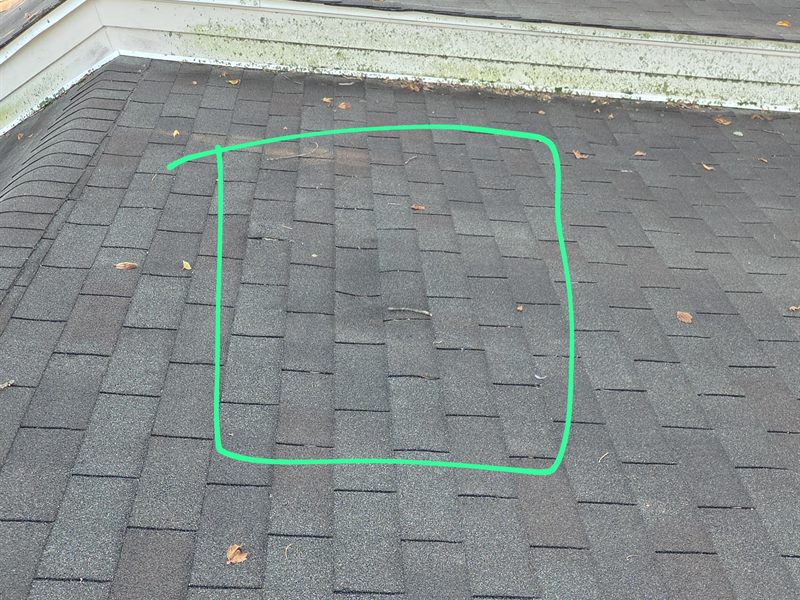
An inspector’s test square. The impacts inside it are counted; that count per square is what an adjuster works from.
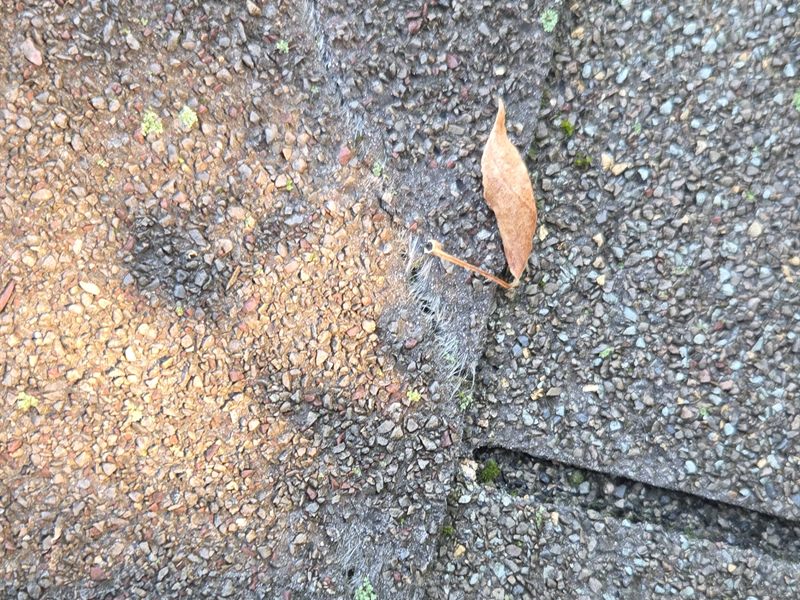
One impact. Granules gone, asphalt bare, and a spot now aging on a clock the rest of the roof is not on.
Photo 3 · Hidden damage, type two, years later
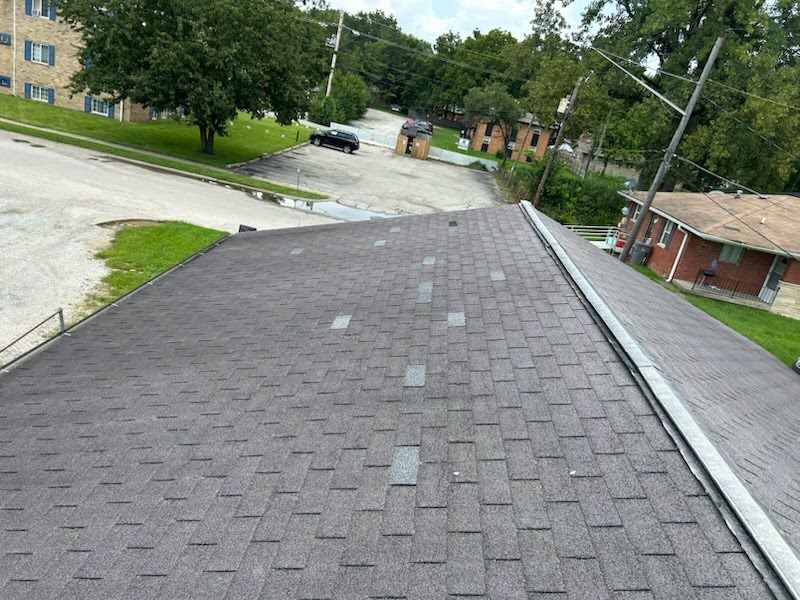
What hidden damage does to a house, and the people in it
The argument for inspecting a roof that looks fine is not that the roof might be secretly ruined. Usually it is not. The argument is that hidden damage compounds, and the compounding runs on a clock that is easy to read once you know it.
Figure 3 · After the storm: how unfound damage develops
Day of
Hail bruises the field. Wind breaks seal strips on exposed edges and caps. A vent cap is dented, a boot cracks. From the ground, nothing has changed.
Weeks
Loosened granules begin washing into gutters. The next ordinary wind lifts the unsealed shingles a little further. Water starts finding the cracked boot in every rain, and traveling along the deck.
Months
Bare asphalt under the bruises is aging in the sun. Insulation below the boot is wet and has lost some of its insulating value. Sheathing begins to stain on the attic side. Still no stain on the ceiling.
A year
The first ceiling stain appears, often far from the entry. Wet insulation and sheathing have supported the conditions mold needs. Many insurance policies have a window for reporting storm damage that may now be closing or closed. Damage that was a covered loss is starting to read as neglect.
Years
Unsealed shingles are gone after a winter wind. Decking under the long-term leak is soft. A repair has become a partial replacement with decking, insulation and drywall in the scope, and the question of who pays has a different answer than it did on day one.
The household risks, stated carefully
Most hidden roof damage threatens your money, not your safety, and it would be dishonest to dress it up. But a few of the downstream effects do reach the people in the house, and they are worth naming precisely.
- Moisture and indoor air. Wet insulation and sheathing that stay wet create the conditions mold grows in, and mold in an attic or ceiling cavity is an indoor-air question before it is a roofing one. Moisture problems found early are a drying job; found late they are a remediation job.
- Water and electrical fixtures. A leak that tracks to a ceiling light or a junction box puts water where it should not be. If a stain is anywhere near a fixture, that is a reason to move faster, not slower.
- Saturated drywall. Ceiling drywall that has absorbed water for long enough sags and can let go. Rare, but it happens, and the warning is the stain that keeps growing.
- Combustion venting. Covered above: a storm-damaged flue cap or crushed vent is a safety item, and a post-storm inspection should treat it as one.
- Structure. Decking that has rotted over years goes soft underfoot, which is a hazard to anyone who walks the roof, and in the worst cases compromises the framing beneath. This is the one that takes the longest to develop and is the most avoidable.
Photo 4 · Where unfound water ends up
Hidden damage is cheapest on the day it happens and most expensive on the day it is found. An inspection moves the second date closer to the first.
The claim clock
Storm damage is a covered loss on most homeowners’ policies, and most policies also expect to hear about it promptly. Many carriers set a window for reporting storm damage, often a year, sometimes longer, and that window runs from the date of the storm, not from the date you noticed the problem. Damage discovered after it closes is harder to claim, and damage that has visibly progressed can be read by an adjuster as wear or neglect rather than the event that caused it.
The practical reading is simple. If a storm with hail or damaging wind has hit your address, the time to find out whether it touched your roof is weeks, not seasons, and the evidence is worth documenting while it is fresh: dated photos of dented gutters and vents, the pile of granules at the downspout, the neighbor’s roof being replaced.
Two cautions that go with the clock. First, a storm is also when the door-knockers arrive, and a company that leads with “your neighbors are all getting new roofs” or offers to handle your deductible is telling you what kind of company it is; Indiana law is specific on the deductible point, and our cost guide covers it. Second, filing a claim is a decision with consequences for your premium, and an honest inspection can tell you the damage is cosmetic and not worth one. That answer is worth as much as the other.
The standard
What a real inspection covers
“Inspection” covers a wide range of effort, from a glance out a truck window to an hour on the roof and in the attic with a camera. The difference is everything, and you can tell which one you are getting by what it produces. A real inspection, from any company, looks like this:
Someone walks the roof. Every slope, not the one facing the street. Hail assessment in particular is done up close, slope by slope, because bruising is felt and seen at arm’s length, not from a ladder. Where a roof is too steep or fragile to walk, the inspector says so and uses a drone or a ladder at each edge rather than guessing.
Every detail gets checked. Each penetration and boot, the flashing at every wall and chimney, the ridge and hip caps, the valleys, the drip edge and first course at every eave. These are the six points on the failure map, and they are where the findings usually are.
The attic is part of the roof. Where it is accessible, the underside tells the truth: staining, daylight, wet insulation, condensation, the air leaks that drive ice dams. An inspection that never goes inside has skipped the best evidence.
You get the findings, with the photos. Written, specific, and tied to pictures you can look at yourself. “Your roof is shot” is a sales line. “Hail bruising on the west and south slopes, photos 4 through 11, none on the north, boots on two of three penetrations cracked” is an inspection.
“Nothing wrong” is an allowed result. An inspection that always finds a roof replacement is not an inspection. The honest version tells you the roof has years left, what to watch, and when to look again.
The National Roofing Contractors Association has recommended for decades that homeowners have a roof looked at in spring and in fall, and after any significant hail or wind. That cadence is aimed at exactly the problem this guide describes: catching the small, hidden things on the day they are small.
Who to let on your roof
Getting the roof inspected matters more than who does it, and there are several reasonable routes. A home inspector during a purchase. An independent roof consultant, if you want findings with no repair business attached. A roofing contractor you already trust, or one you are vetting for a job. After a storm, your insurer’s adjuster will inspect too, though that inspection exists to scope a claim rather than to advise you.
Whatever route you take, the standards in the previous section are the test. Ask up front whether they walk the roof and enter the attic, and whether you will receive written findings with photographs. A company that will not commit to those three things is offering a sales visit with a different name.
And pay attention to how they talk about the result. An inspector who can say “it is fine, check it again in two years” without visible disappointment is the one whose “it needs work” you can believe.
If you are in Indianapolis or Central Indiana
Indy Roof Pros offers a free inspection to the standard above: every slope walked, every detail and the attic checked, written findings with photographs, and an honest “not yet” when that is the answer. It is one option among the routes listed, and it is there if you suspect storm damage or are carrying a roof of uncertain age.
Schedule a Free Roof Inspection