
Guide · Cost & budgeting
Roof replacement cost in Indianapolis: a 2026 budget guide
A roof is one of the few five-figure purchases most people make without ever being shown how the number is built. So here is how it is built: the unit everything is quoted in, the geometry that makes your roof bigger than your house, what Central Indiana actually charges in 2026, the line most budgets forget, and how to read two proposals that are four thousand dollars apart.

Most homeowners meet their roof budget backwards. A number arrives on a proposal, it is larger than expected, and the only available move is to compare it against another number that arrived the same way. Nobody explains the arithmetic, so the decision comes down to which salesperson seemed more trustworthy.
That is a bad way to spend twelve thousand dollars, and it is completely avoidable. Roof pricing is not mysterious. It is a unit, a measurement, a short list of variables, and a contingency. Once you can do the arithmetic yourself, a proposal stops being a verdict and becomes a document you can actually interrogate.
This guide will not give you a price for your roof, because nobody honest can do that from a web page. What it will give you is the ability to build a defensible planning number, and then check the one somebody hands you against it. The figures below are published Indianapolis pricing ranges available in 2026, not one company's price list, and the sources are at the bottom.
Start with the unit, not the total
Residential roofing in the United States is priced in squares. One square is 100 square feet of roof surface. Not one hundred square feet of your floor plan, and not one bundle of shingles, though bundles are a useful sanity check: most architectural shingles run three bundles to the square.
The square is the unit that makes two proposals comparable. A total price is hard to interpret until you know how many squares it covers. A price per square tells you where a bid sits in the market, which is most of what a comparison needs.
Which leads to the first thing almost everyone gets wrong.
Your roof is bigger than your house
A roof is a slope, and a slope is longer than the ground it covers. Roofers describe that slope as a pitch: a 6:12 roof rises six inches for every twelve inches it runs horizontally. The steeper it is, the more surface there is above the same footprint, and the more it costs to work on, because steep roofs are slower and demand more staging and fall protection.
The conversion is just geometry. It is worth knowing, because it is the difference between a planning number that is roughly right and one that is 20% low before you have even started.
Figure 1 · Why footprint is not roof area
To convert, multiply the footprint your roof covers by the multiplier for its pitch. Measure to the drip edge rather than to the wall, because overhangs are roof too, and on a house with generous eaves they are not a rounding error.
| Pitch | Multiplier | Added area |
|---|---|---|
| 3:12 | 1.03 | +3% |
| 4:12 | 1.05 | +5% |
| 5:12 | 1.08 | +8% |
| 6:12 | 1.12 | +12% |
| 8:12 | 1.20 | +20% |
| 10:12 | 1.30 | +30% |
| 12:12 | 1.41 | +41% |
A 6:12 is a common residential pitch and a reasonable default if you are estimating without a measurement. But guessing is exactly the part you should stop doing once somebody is standing on the roof with a tape measure.
What Central Indiana actually charges
Published Indianapolis pricing ranges available in 2026, taken together, put a full asphalt shingle replacement at roughly $4.00 to $7.50 per square foot of roof surface, installed, with tear-off included. Converted into the unit that matters, that is about $400 to $750 per square across the whole market.
That full span is wide because it covers everything from a basic three-tab install on a simple ranch to premium product on a steep, cut-up roof. For planning purposes, the more useful figure is the middle of the market: $450 to $600 per square for a standard architectural asphalt replacement on a typical Central Indiana home. Local guides and calculators put the resulting total for an average single-family house somewhere around $9,000 to $16,000, with the full market spanning roughly $8,000 to $30,000 once very small and very large roofs are included.
Now put those together with the geometry. Here is the whole calculation on a house we will invent: a two-story home whose roof covers about 2,150 square feet measured to the eaves, at a 6:12 pitch.
Figure 2 · Footprint to budget, in five steps
Want the measured number for your roof instead of the worked example? The inspection is free and the price comes back in writing.
Schedule a Free Roof InspectionTwo things not to do with this number
Do not add a waste factor on top. Roofs are cut to fit, so material always gets ordered above the measured area, roughly 10% on a simple gable and up to 15% on a roof full of hips and valleys. That allowance already sits inside a per-square price. Adding it yourself double-counts it and inflates your budget by a thousand dollars for no reason.
Do not treat it as a quote. It is a planning number: correct for deciding whether to start saving, whether a claim is worth filing, or whether a proposal in front of you is in a sane neighborhood. It is wrong for signing anything, because it knows nothing about your decking, your flashing, your ventilation, or how many layers are up there.
The same 24 squares can be a straightforward gable or a cut-up multi-hip with six valleys and two chimneys. Identical square counts, opposite ends of the range.
This is why per-square pricing is a comparison tool rather than a formula. Complexity does not add squares; it adds hours, cuts, waste and detail work across the squares you already have. A roof with a lot of edges is a roof with a lot of places for water to get in, and every one of those places is labor.
Where the money actually goes
Knowing the shape of the spend is what lets you tell a competitive bid from a hollow one. The proportions move with the roof, since a steep, cut-up job shifts weight toward labor and a premium shingle line shifts it toward materials, but the shape below is broadly what sits behind a residential asphalt replacement.
Figure 3 · The shape of a roofing dollar
Now look at that chart as a contractor trying to win a bid by four thousand dollars. Materials and labor are the big blocks, but they are hard to cut without it showing: a cheaper shingle is visible on the proposal, and a thinner crew shows up in the schedule.
The two blocks that are easy to cut invisibly are detail work and the overhead block that contains insurance. Reusing chimney flashing instead of rebuilding it, sealing a valley instead of membraning it, skipping the ventilation correction, leaving the old drip edge on: none of that appears as a line saying “removed.” It appears as silence. And an uninsured crew is dramatically cheaper right up until somebody is hurt on your property.
A price alone cannot tell you whether a cheaper bid is efficiency or missing scope. The written scope can, so read for what is absent.
This is not an argument that the expensive bid is always right. Plenty of high bids are just high, and a cheaper company may simply carry less overhead or accept a thinner margin. It is an argument that price differences have causes, and the causes are findable if you ask about the right three or four things, which we will get to.
The line most budgets forget
Nobody, no matter how good, can see the wood under your shingles until the shingles are off. A thorough inspection finds the evidence of a bad deck: soft spots underfoot, sagging between rafters, staining or daylight visible from inside the attic. But evidence is not the same as certainty, and the certainty arrives on tear-off day.

So carry a contingency. Ten percent above the contract price is a sensible figure for a roof in average condition, and you should expect not to spend most of it. If the roof is older, has been leaking, or has a history of patch repairs, plan closer to fifteen.
Make the contingency a known price, not an unknown one
A contingency is only useful if you know the rate it will be spent at. Spot decking replacement during a reroof commonly runs $75 to $150 per 4×8 sheet installed, covering the sheet itself, the labor to cut out the bad section, new material nailed to code, and hauling the rotted wood away. One sheet is 32 square feet, so a roof needing eight sheets is a $600 to $1,200 addition, well inside a 10% contingency on a $12,000 job.
Before you sign anything, get these three things in writing:
- The unit price for replacement decking, and whether it changes for plank sheathing, which older Indianapolis homes often have instead of plywood.
- The approval rule: work pauses, you get photographs of what was found, you get a written price on the terms already in the contract, and nothing proceeds until you say so.
- Whether the price assumes one existing layer. A second layer means twice the tear-off and twice the disposal, and finding it on the morning of is an expensive surprise for everybody.
Photo · What tear-off exposes
An Indianapolis roof we replaced this month, photographed the morning the old shingles came off: rotted plank sheathing with a hole straight through into the attic, and the new plywood already going down beside it. Until tear-off nobody, including us, knew this was there. The proposal had already named the per-sheet price and the approval rule, so the photos went to the homeowner, the sheet count was priced on the terms already signed, and the work waited for a written yes. A deck like this is the whole reason that rule exists.
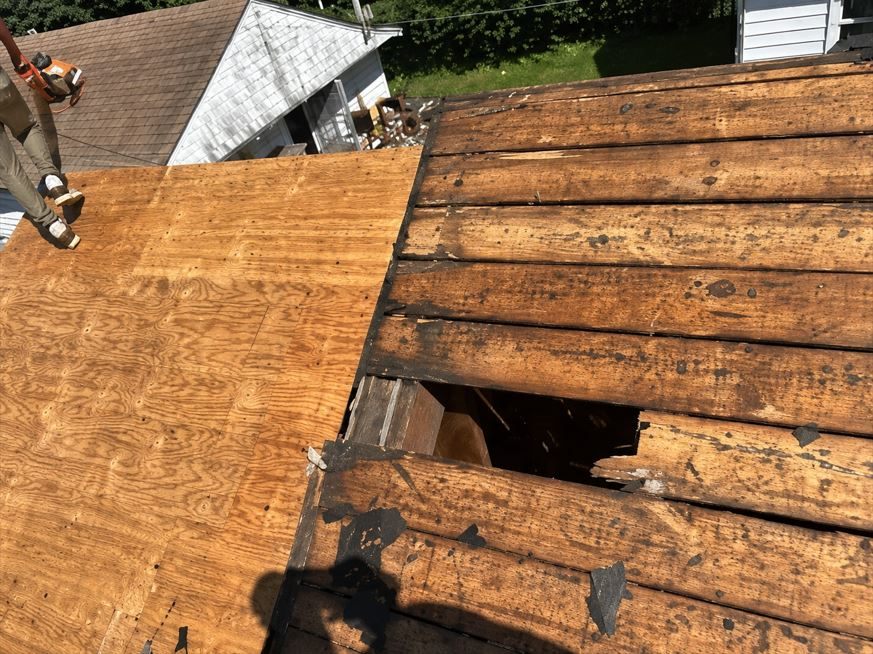
A proposal that says nothing about decking has not given you a lower price. It has given you an open-ended one, and the number will be set on a day when you have no leverage and half a roof.
The other things that surface once the roof is open: rotted fascia behind the gutter line, ventilation that was never adequate and now has to be brought up to a workable intake-and-exhaust balance, and chimney flashing buried under years of sealant instead of rebuilt. None of those are rare. All of them are cheaper to have thought about in advance.
What actually moves your number
Homeowners tend to spend their deliberation on the shingle: the color, the brand, the tier. It is the most visible decision and the least consequential one on this list. Here is the honest ranking of what your money responds to.
Size · high leverage
Squares are the base everything multiplies against. This is the single biggest determinant and the one you cannot change.
Pitch and access · high leverage
Steeper roofs add surface area and slow the crew down. Trees, tight lots, second stories and nowhere to put a dumpster all add hours.
Layers to remove · high leverage
Two layers doubles tear-off labor and disposal volume. This is one of the most common reasons two bids disagree.
Decking condition · high leverage
Unknown until tear-off, which is exactly why it needs a written unit price and an approval rule before you sign.
Complexity · medium to high
Valleys, hips, dormers, skylights and roof-to-wall intersections. Every one is cuts, waste and detail labor on top of the same square count.
Flashing work · medium
Rebuilding chimney step and counterflashing costs real money. Reusing it costs nothing today and quite a lot in about four years.
Ventilation correction · medium
Converting to balanced soffit-to-ridge airflow, or adding intake that was never there. Often the difference between a roof that reaches its rated life and one that cooks.
Shingle line · low to medium
Moving up a tier is a real cost, but it is a smaller swing than pitch or layer count. Color costs nothing.
If your budget is tight, the productive conversation is about scope sequencing, for example whether a detached garage becomes a separate project next year. It is not about shaving the underlayment or the flashing. You cannot half-replace a roof. You can sometimes replace fewer roofs at once.
Where the money comes from
Four routes, and most people end up using two of them.
Cash, ideally set aside on purpose
The cheapest possible way to buy a roof, and the one that requires having started years ago. There is a fix for that at the end of this guide.
An insurance claim
Central Indiana gets hail and straight-line wind, and storm damage is a legitimate covered loss on most homeowners’ policies. What surprises people is not whether it pays, but how it pays: on a typical replacement-cost policy, in two checks, with a gap in the middle that you may have to bridge. Payment structures vary by carrier and policy, but the pattern below is the common one.

Figure 4 · How a replacement-cost claim typically pays out
Step 1 · The carrier scopes the loss
An adjuster writes an estimate of what it costs to replace what was damaged. That full figure is the replacement cost value (RCV).
WORKED EXAMPLE · RCV $14,000
Step 2 · Depreciation and deductible come off
The carrier subtracts depreciation for the age and wear of the old roof, then subtracts your deductible. What is left is the actual cash value (ACV).
$14,000 − $4,200 DEPRECIATION − $1,500 DEDUCTIBLE = $8,300
Step 3 · First check arrives
You receive the ACV amount. On a large loss this is often materially less than the job costs, and if you have a mortgage the check may be issued jointly with your lender.
CHECK 1 = $8,300
Step 4 · The work is completed and documented
The contractor submits the final invoice and completion documentation. Depending on the contractor’s payment schedule and the carrier’s process, you may temporarily bridge some or all of the remaining balance.
INVOICE $14,000 · YOU MAY BRIDGE UP TO $5,700, PER THE PAYMENT SCHEDULE
Step 5 · Second check, if your policy is RCV
Once the carrier receives evidence the replacement was completed, the withheld depreciation is released. This is the recoverable depreciation. Policies written at actual cash value only never release it, and some carriers apply an age-based roof payment schedule that limits it.
CHECK 2 = $4,200 · FINAL OUT OF POCKET = THE $1,500 DEDUCTIBLE
Two timing traps live inside that diagram. The first is the bridge: whether you front anything beyond the deductible, and for how long, is set by the contractor’s payment schedule, so read that schedule against the claim timeline before signing and ask the carrier what documentation releases the withheld amount. The second is the clock, because most policies set a deadline for completing the work if you want the recoverable depreciation, and letting it lapse converts a covered loss into a partially covered one.
One thing to refuse outright. If a contractor offers to “cover,” “waive” or “eat” your deductible, walk away. Indiana’s Home Improvement Contract Act, at Ind. Code § 24-5-11-10.5, specifically bars a home improvement supplier from advertising, offering or promising to pay or rebate any part of an insurance deductible to induce a contract, and inflating an estimate to absorb one may constitute insurance fraud. It is also a straightforward preview of how that company handles the things you will not be there to see.
Financing
Contractor-arranged financing, a home equity line, a credit union home improvement loan and a promotional credit card are all real options with very different costs. Whatever a contractor offers, ask for the APR, the term, and the total cost of the financed amount rather than the monthly payment. A monthly payment is not a price, and quoting one instead of a price is a sales technique rather than a disclosure.
Splitting the project
Rarely available, occasionally the right answer. A house and a detached garage can genuinely be two projects in two budget years. A single roof plane cannot be half done, and any proposal suggesting otherwise is describing a repair, not a replacement.
Reading two proposals that are thousands apart
The standard advice is to get three bids. It is fine advice and almost useless on its own, because three prices for three different scopes is not a comparison. It is three unrelated numbers.
Do this instead. Divide each total by that contractor’s own measured square count. Now you have three prices for the same unit, and you can see immediately which of them sit inside the $450 to $600 mid-market band and which do not. If the square counts differ from each other by more than a few percent, ask why before assuming anything: one bid may state net measured squares while another folds the waste allowance into its count, or somebody genuinely measured wrong. Finding out which is more valuable than any of the prices.

Then read for scope. Every proposal you are considering should let you answer all twelve of these without phoning anyone.
1 · Measured squares and pitch
Their number, from their measurement. Without it, nothing else is comparable.
2 · Layers being removed
And what happens to the price if a second layer turns up that nobody expected.
3 · Decking rule and unit price
Per sheet, in writing, with the approval process spelled out.
4 · Underlayment type and coverage
Synthetic or felt, and over the whole deck or only in places.
5 · Ice-and-water membrane locations
Eaves, valleys, low-slope sections. Named locations, not the phrase “where required.”
6 · Flashing: rebuilt, reused or sealed
The single largest hidden difference between two bids. Ask it in exactly those words.
7 · Ventilation, intake and exhaust
Both halves. Exhaust without intake does not ventilate an attic, it just has a vent on it.
8 · Drip edge and edge metal
New or existing. Old drip edge left in place under a new roof is a genuine corner being cut.
9 · Permit: who pulls it, who pays
Requirements and fees vary by municipality across Central Indiana, typically running from around $75 to $200. Confirm it is handled and priced.
10 · Cleanup standard
Debris containment, gutter clearing, magnetic nail sweep, and what “finished” means.
11 · Warranty, both kinds
Workmanship term from the contractor, and the manufacturer level. Enhanced manufacturer coverage usually requires specific accessories and certified installation, so ask what this bid actually qualifies for.
12 · Payment schedule
What is due when. A large deposit before materials are on site deserves a question.
Two bids four thousand dollars apart usually differ in three places: layers, flashing and ventilation. Ask about those three and most of the gap explains itself.
If it does not explain itself, and the cheaper proposal matches the expensive one point for point while the contractor can talk through every item, then you have found a genuinely better price. That does happen. The checklist is not there to justify paying more. It is there to make sure that when you pay less, you know what for.
When to spend it
Timing changes both what you pay and what you get.
Spring and early summer are the busy season here, because that is when storms come through and everyone files at once. Schedules stretch, good crews book out, and the market fills with companies that were not in Indiana in March. Nothing about that makes spring a bad time to replace a roof. It makes it a bad time to be in a hurry.
Late fall and winter are quieter, but asphalt shingles carry a real constraint: the adhesive strips that bond one course to the next need warmth and sun to seal. Installed in the cold, a roof may not seal until spring, which is why manufacturers publish cold-weather instructions including hand-sealing. Winter installation is not wrong. Asking a contractor how they handle sealing in the cold, and getting a specific answer, is the point.
Waiting is free right up until it is not. A roof at the end of its service life that is not leaking costs you nothing to keep for another season. A roof that is letting water into the deck converts a zero-dollar line into a $75 to $150 decking line every time it rains, and once water reaches insulation and drywall you no longer have a roofing project. You have a roofing project and an interior one.
The corollary matters just as much: if the honest answer is that your roof still has years left, that is the cheapest money you will ever save. We would rather tell you that and do the work when it is genuinely time.
The long game
Never be surprised by this again
A roof does not have to be an emergency. Neglected long enough it certainly becomes one, and roofing emergencies are real: a failed roof in a February storm does not wait for a convenient quarter. But a roof announces itself for years before that point. It is a component with a service life, which makes it the most predictable large expense a house has, and the only reason the bill ever feels sudden is that almost nobody saves toward a date they could have read off the shingles.
The arithmetic is one line: take your planning number, divide it by the years you realistically have left, and set that aside annually. Using the midpoint of the worked example above, about $12,500:
Two households, same roof
New roof, 20 years of runway
$52 / month
$12,500 ÷ 20 years
Roof at year 15, 5 years left
$208 / month
$12,500 ÷ 5 years
Round the target up a little, because you are saving toward a future price rather than today’s. And re-baseline it after every inspection. The number that matters is not the roof’s age, it is how many years the roof actually has left, and those are different figures.
Fifty-two dollars a month is not a hardship. Twelve thousand five hundred in a single week is. The whole difference between those two experiences is whether anyone told you the arithmetic in time.
Seven things that should end the conversation
None of these are about being difficult. Each one is a company telling you something about how it operates, early enough that it costs you nothing to listen.
A firm price before anyone has looked at the roof. Aerial measurement is a legitimate tool and gets size and pitch close. What no image can show is layer count, decking condition, flashing and ventilation, so a firm number produced without an on-site look is an opening position, not an estimate.
A price that expires today. Roofing materials do not become worthless overnight. Urgency in a quote is a sales instrument, not a market condition.
No mention of decking. Silence on the one genuinely unknowable item is not a lower price. It is an unpriced item.
A monthly payment quoted instead of a price. Ask for the price. Then ask for the financing terms separately. They are two different pieces of information and combining them hides both.
An offer to handle your deductible. Covered above, and worth repeating: Indiana law (Ind. Code § 24-5-11-10.5) specifically prohibits offering it, and the claim carries your name rather than theirs.
A proposal you cannot read. One page, one number and a signature line is not a scope. If you cannot tell what you are buying, neither can anyone else, including whoever has to honor it later.
Reluctance to put change handling in writing. How a company behaves when something unexpected turns up is the entire question, and the time to settle it is before the shingles come off.
What a finished budget looks like
Three numbers, not one.
The planning number
Squares multiplied by a market rate. Built from geometry, good enough to decide with, never good enough to sign.
The contract number
One complete price for a written scope, measured on site, with assumptions and exclusions stated.
The contingency
Ten percent, held against a known unit price for decking and an approval rule you have already read.
If you have all three, the project has almost no capacity to surprise you financially. That is really all a budget is for. It is not about spending less. It is about knowing, before the first shingle comes off, what the range of outcomes is and having covered every one of them.
And when you do get proposals, read them against the twelve points above rather than against each other. The cheapest complete scope is a good deal. The cheapest incomplete scope is just the same roof with the difficult parts deferred to whoever owns the house when they fail.